Dehumidifier Buying Guide
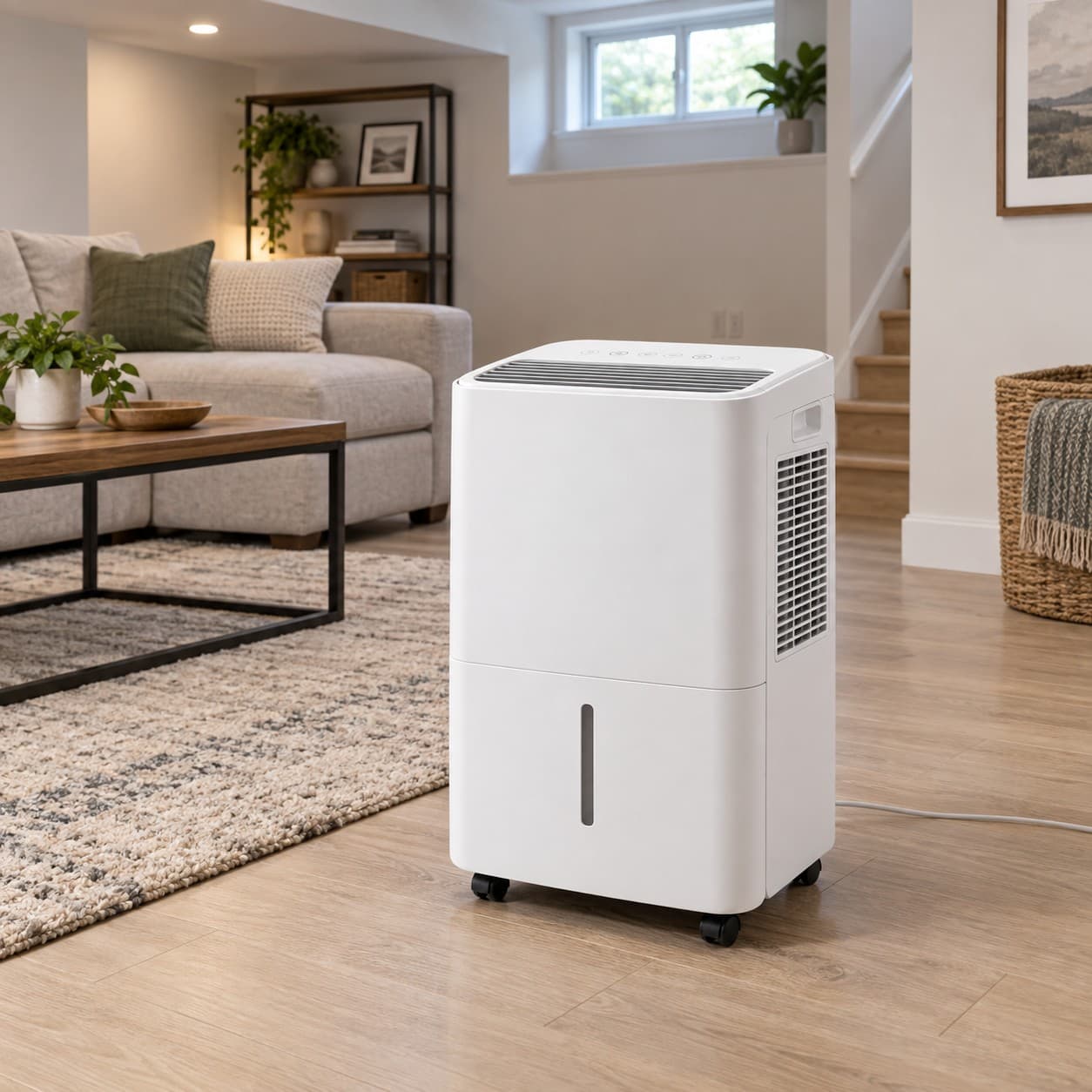
Type
The technology inside the unit determines how much water it pulls, how loudly it works, and whether it functions at all in a cold basement. This is the first fork in the road, so get it right before comparing anything else.
- Compressor - The classic refrigerant-based workhorse. It chills a coil so moisture condenses out, and it dominates the mid and large capacity range. Most efficient in warm, humid conditions above roughly 65°F, which makes it the default pick for basements, living areas, and whole floors.
- Thermoelectric - Uses a Peltier chip instead of a compressor. Small, light, very quiet, and cheap, but pulls only a modest amount of water per day. Perfect for a closet, bathroom, or small bedroom; badly overmatched by a damp basement.
- Desiccant - Absorbs moisture with a drying material rather than cold coils. Its big advantage is cold-weather performance, so it shines in unheated garages, crawl spaces, boats, and RVs where a compressor unit would frost over and stall.
- Rechargeable Silica Gel - Cordless mini units you plug in periodically to dry out the beads, then place back in a gun safe, wardrobe, or car. No noise, no power draw in use, tiny capacity. Strictly for enclosed micro-spaces.
- Non-Electric Moisture Absorber - Disposable tubs or hanging bags of absorbent salts. Cheap, silent, and maintenance-light, though you're buying refills forever. Good for a damp cupboard or a seasonal cabin.
- Whole House - Ducted or high-capacity standalone systems for multi-room or full-home humidity control. Significant investment and often installation, but the only real answer for a persistently damp house.
Compressor for anything sizeable and warm, desiccant for cold spaces, thermoelectric or silica gel for small enclosed spots. Buying a thermoelectric unit for a basement is the single most common and most disappointing mistake in this category.
Capacity
Capacity is measured in pints of water removed per 24 hours and is the headline number on every listing. Be aware that many brands quote capacity under generous lab conditions, so real-world output in your room will usually be lower.
- Under 10 Pint - Mini units, typically thermoelectric. Suited to a closet, small bathroom, or a single-occupant bedroom with mild dampness. Expect to empty a small tank often.
- 10 to 19 Pint - Entry-level for a real room. Handles a bedroom, office, or small apartment space with noticeable but not severe humidity.
- 20 to 29 Pint - A sensible mid-range for bedrooms, laundry rooms, and medium living areas. Often the best balance of price, size, and performance for average homes.
- 30 to 39 Pint - Strong performer for damp basements under moderate size, or open-plan main floors. Popular with Midea, Frigidaire, and hOmeLabs buyers.
- 40 to 49 Pint - Serious moisture control for larger or wetter basements, especially in humid climates. Frequently paired with continuous drainage since tanks fill fast.
- 50 to 69 Pint - Heavy-duty territory for large basements, workshops, and homes with recurring dampness or mildew smells.
- 70 to 100 Pint - Commercial-grade output for flood recovery, crawl spaces, and very large or very wet areas. Physically big, heavier on electricity, and generally overkill for a single room.
Match capacity to both the square footage and how wet the space actually is; a merely musty room needs far less than one with standing dampness. When in doubt, sizing slightly up lets the unit reach target humidity faster and cycle off, which is usually quieter and more efficient than a small unit running nonstop.
Coverage Area
Coverage area tells you the square footage the manufacturer claims the unit can service. Treat it as a guideline rather than a guarantee, since ceiling height, airflow between rooms, and severity of dampness all shift the math.
- Under 300 Sq Ft - Closets, bathrooms, pantries, RVs, and small bedrooms. Almost always paired with mini or thermoelectric designs.
- 300 to 999 Sq Ft - Standard bedrooms, offices, nurseries, and small apartments. The most common range for compact compressor units.
- 1000 to 1999 Sq Ft - Typical finished basements, larger living rooms, and small homes. A very popular bracket for 30 to 40 pint models.
- 2000 to 2999 Sq Ft - Large open basements and full floors of an average house. Expect a 40 to 50 pint compressor unit here.
- 3000 to 3999 Sq Ft - Big basements, workshops, and larger homes with an open layout that lets air circulate to the unit.
- 4000 to 4999 Sq Ft - Heavy-duty units for very large spaces or persistently wet environments such as poorly sealed crawl spaces.
- 5000 to 8000 Sq Ft - Commercial and whole-home claims. Genuine coverage at this level requires good airflow throughout the space, often with ducting or fans.
A dehumidifier only dries air that reaches it, so a single unit rated for 3000 sq ft will not dry three closed bedrooms. For segmented layouts, either place the unit centrally with doors open or buy two smaller units instead of one giant one.
Drainage
Drainage is the feature people underestimate and then complain about in reviews. A high-capacity unit can fill its tank in hours, so how the water leaves matters as much as how fast it's collected.
- Removable Water Tank - The default. Simple, portable, and fine for low-humidity rooms, but it means manual emptying. Look for a tank with a carry handle, a splash guard, and a clear window so you can see the level without pulling it out. Full-tank auto shut-off is essential here.
- Drain Hose - Continuous gravity drainage through a hose to a floor drain or sump. Costs nothing extra and turns the unit into a set-and-forget appliance, provided the drain sits lower than the outlet port. Check whether a hose is included; many brands ship without one.
- Built-In Pump - An internal pump pushes water upward and out, so you can drain into a sink, window, or utility tub above the unit. The best option for basements without a floor drain, and worth the premium if manual emptying isn't practical. Pumps add a bit of noise and are the most common component to eventually fail.
If the unit will run daily in a basement, prioritize continuous drainage over everything else on the spec sheet. Gravity hose if you have a low drain, pump if you don't, and tank-only if the unit is for occasional use in a living space.
Tank Size
Tank size decides how often you play water-carrier. It's usually listed in ounces or liters, and it should be read alongside the pint capacity: a big extractor with a small tank means constant trips to the sink.
- Under 30 Oz - Found on mini and thermoelectric units. Expect to empty daily, sometimes twice a day in humid weather.
- 30 to 49 Oz - Small bedroom and bathroom units. Manageable to carry, still frequent emptying.
- 50 to 79 Oz - A comfortable middle ground for compact compressor models in bedrooms and offices.
- 80 to 99 Oz - Common on mid-size units. Roughly a day of runtime in moderately damp conditions.
- 100 to 199 Oz - Typical of 30 to 50 pint basement units. Full tanks get heavy, so check for a wide handle and a spout that won't slosh.
- 200 to 500 Oz - Large reservoirs on high-capacity machines. Fewer trips, but a full tank can be genuinely awkward to lift, which is exactly why these models are usually run on a hose instead.
Bigger tanks reduce hassle but increase carrying weight, so consider who will be emptying it. If a tank over about 150 oz sounds heavy, plan on continuous drainage from day one.
Room Use
Manufacturers list intended rooms for good reason, because a unit optimized for a gun safe has nothing in common with one built for a basement. Match the design to the environment, particularly regarding temperature and size.
- Basement - The most common use case. Wants high capacity, continuous drainage, caster wheels, and auto defrost for cooler months.
- Bedroom - Noise is king. Look for sleep mode, a dimmable or off display, and a rating under 40 dB.
- Bathroom - Small, humid, and often unventilated. A compact unit with a washable filter and rust-resistant housing works best.
- Closet - Mini thermoelectric or rechargeable silica gel units that fit on a shelf without a cord trailing out the door.
- Garage and Crawl Space - Cold and often unheated. Desiccant or a compressor unit with reliable auto defrost is necessary, otherwise the coils ice up and output collapses.
- Laundry Room - Look for a laundry drying mode that runs the fan at maximum to speed up air-drying clothes.
- Living Room and Office - Appearance and quiet matter; slim profiles and neutral colors suit these spaces.
- RV, Car, and Boat - Compact, vibration-tolerant, and ideally cordless or low-draw. Silica gel units are popular because there's nothing to spill in transit.
- Gun Safe - Rechargeable silica gel canisters or low-wattage rod heaters that protect metal from corrosion in a sealed box.
- Grow Tent - Needs precise humidity control and continuous drainage, often with a humidistat that holds a tight target range.
Think about temperature first, then size. A cold space narrows you to desiccant or auto-defrost compressor units, while a small enclosed space usually rules out anything large regardless of how good the reviews are.
Features
Beyond raw capacity, features are what make a dehumidifier pleasant to live with rather than an appliance you resent. A few are genuinely important; others are nice extras.
- Auto Shut-Off - Stops the unit when the tank is full so it doesn't overflow. Non-negotiable on any tank-based model.
- Auto Defrost - Detects frost on the coils and pauses compression to melt it. Critical for basements, garages, and any space that drops below roughly 65°F.
- 24H Timer - Lets you run the unit only during off-peak hours or while you're out, which trims both energy use and noise exposure.
- Humidity Display - Shows current room humidity so you can set a real target, usually 45 to 55 percent. Without it you're guessing.
- Washable Filter - Rinse and reuse rather than buying replacements. Saves money and keeps airflow strong, which directly affects extraction rate.
- Caster Wheels - Essential on anything over about 30 pints. These units are heavy, and integrated handles plus wheels make moving them realistic.
- Laundry Drying Mode - Runs continuously at high fan speed to dry clothes indoors. Genuinely useful in apartments without outdoor drying space.
- Auto Restart - Resumes previous settings after a power cut. A quiet hero in basements where outages go unnoticed for days.
- Sleep Mode and Night Light - Sleep mode dims lights and lowers fan speed for bedrooms; a night light helps in dark basements and hallways.
- Adjustable Fan Speed and Swing Airflow - Speed control lets you trade noise for output, while swing louvers distribute dry air more evenly across a room.
- Child Lock - Freezes the control panel so curious hands can't change settings or shut the unit off.
Prioritize auto shut-off, auto defrost, a humidity display, and a washable filter as your baseline. Everything else is convenience, worth paying for only if it matches how and where you'll actually run the machine.
Noise Level
A dehumidifier runs for hours at a stretch, so noise is a daily quality-of-life issue rather than a footnote. Ratings are measured at a set distance under ideal conditions, so add a few decibels for real rooms and hard floors.
- Silent Under 30 dB - Essentially inaudible, achievable only with thermoelectric or desiccant-free absorber designs. Comes with very low extraction capacity.
- Quiet 30 to 39 dB - Library-level hum. The target range for bedrooms and nurseries, and a genuine selling point on compact compressor units with a sleep mode.
- Moderate 40 to 49 dB - Comparable to a refrigerator. Perfectly fine for living rooms, offices, and basements, and where most mid-size compressor units land.
- Loud 50 to 65 dB - Noticeable conversation-level noise. Typical of high-capacity and pump-equipped units. Acceptable in a basement or garage, unpleasant anywhere you sleep or work.
Decide where the unit lives before caring about decibels. Bedrooms demand under 40 dB and a sleep mode, while a basement two floors down can happily host a louder, more capable machine.
Smart Controls
Smart connectivity is increasingly common on mid and premium models, and it's most valuable when the unit sits somewhere you rarely visit. Being able to check humidity in a crawl space from your phone beats walking down with a flashlight.
- Wi-Fi - The foundation for remote access. Verify the unit supports your network band, as many models only work on 2.4 GHz, which matters in basements with weak signal.
- App Control - Set target humidity, change modes, view tank status, and schedule runtime from anywhere. The most practically useful smart feature by far.
- Alexa and Google Assistant - Voice commands for on, off, and mode changes. Convenient if you're already in that ecosystem, largely cosmetic if you're not.
- Remote Control - A simple infrared handset. No app, no account, no network dependency. Underrated for units placed high on shelves or across a large room.
App control earns its keep on units in basements, crawl spaces, and second homes where you want alerts and remote checks. For a bedroom unit you interact with daily, a decent control panel or a basic remote is often all you need.
Energy Rating
Dehumidifiers can run most of the day during humid months, so efficiency has a real effect on your bill. Ratings compare water removed per unit of electricity, not just wattage.
- Energy Star Certified - Meets federal efficiency standards and typically uses noticeably less power than an uncertified model of the same capacity. The sensible default for any unit running daily.
- Energy Star Most Efficient - The top tier, reserved for the best performers each year. Higher upfront cost that pays back fastest in humid climates with long running seasons.
- Standard Efficiency - No certification. Often cheaper to buy and common among mini and thermoelectric units, where the small power draw makes certification less meaningful. On a large compressor unit, though, standard efficiency can cost you real money over a season.
For anything 30 pints or larger that will run regularly, pay the small premium for Energy Star. For a tiny closet unit used occasionally, the rating hardly matters.
Brands
The dehumidifier market splits into established appliance names and a large group of direct-to-Amazon brands offering strong specs at lower prices. Both can serve you well; what differs is warranty support and long-term parts availability.
- Midea - One of the largest appliance manufacturers in the world and the actual maker behind many rebadged units. Reliable compressor models with solid efficiency and good pump options.
- Frigidaire - A long-standing name in home dehumidifiers, known for sturdy mid and high-capacity units with strong basement performance and dependable service networks.
- hOmeLabs - An Amazon favorite for value-priced 20 to 50 pint units. Straightforward controls, good capacity for the money, widely reviewed.
- Waykar and Kesnos - Popular specification-heavy brands offering large coverage claims, drain hoses, and casters at competitive prices. Read reviews on longevity rather than just day-one performance.
- Pro Breeze and Eva-Dry - Leaders in the mini and rechargeable segment. Ideal for closets, gun safes, RVs, and bathrooms where a full-size unit makes no sense.
- Honeywell, GE, LG, and Hisense - Mainstream appliance brands with dependable mid to large capacity units, often including built-in pumps and Energy Star certification.
- Whynter, Ivation, and Danby - Specialists with strong offerings in high-capacity, crawl space, and pump-equipped categories.
- Vremi, Colzer, Afloia, Shinco, and Yaufey - Value-oriented brands covering everything from compact bedroom units to large basement machines, usually undercutting legacy brands on price.
- Dreo, ToLife, Tabyik, and NineSky - Newer design-led entrants focused on quiet operation, app control, and compact footprints for bedrooms and offices.
Buy legacy brands when you want warranty backing and serviceability on an expensive high-capacity unit. Direct-to-Amazon brands are excellent value for small and mid-size needs, provided you check recent reviews for compressor reliability past the one-year mark.
Color
Color is the last thing to worry about, but it matters if the unit lives in a visible room rather than a utility space. Finish also affects how obvious dust and scuffs become.
- White - The most common option. Blends into most interiors and looks clean, though it shows scuffs on baseboards and basement walls.
- Black - Hides marks well and suits modern or dark-toned rooms. Dust is more visible on matte black surfaces.
- Gray and Silver - Neutral, slightly more contemporary, and forgiving of both dust and minor scratches. A safe pick for living rooms and offices.
- Blue and Beige - Less common accent finishes, generally found on compact or novelty units aimed at bedrooms and nurseries.
For basements and garages, ignore color entirely and spend the attention on capacity and drainage. For a bedroom or living room unit, a neutral white, gray, or black keeps a fairly bulky appliance from dominating the room.