Plasma Cutter Buying Guide
Cut Thickness
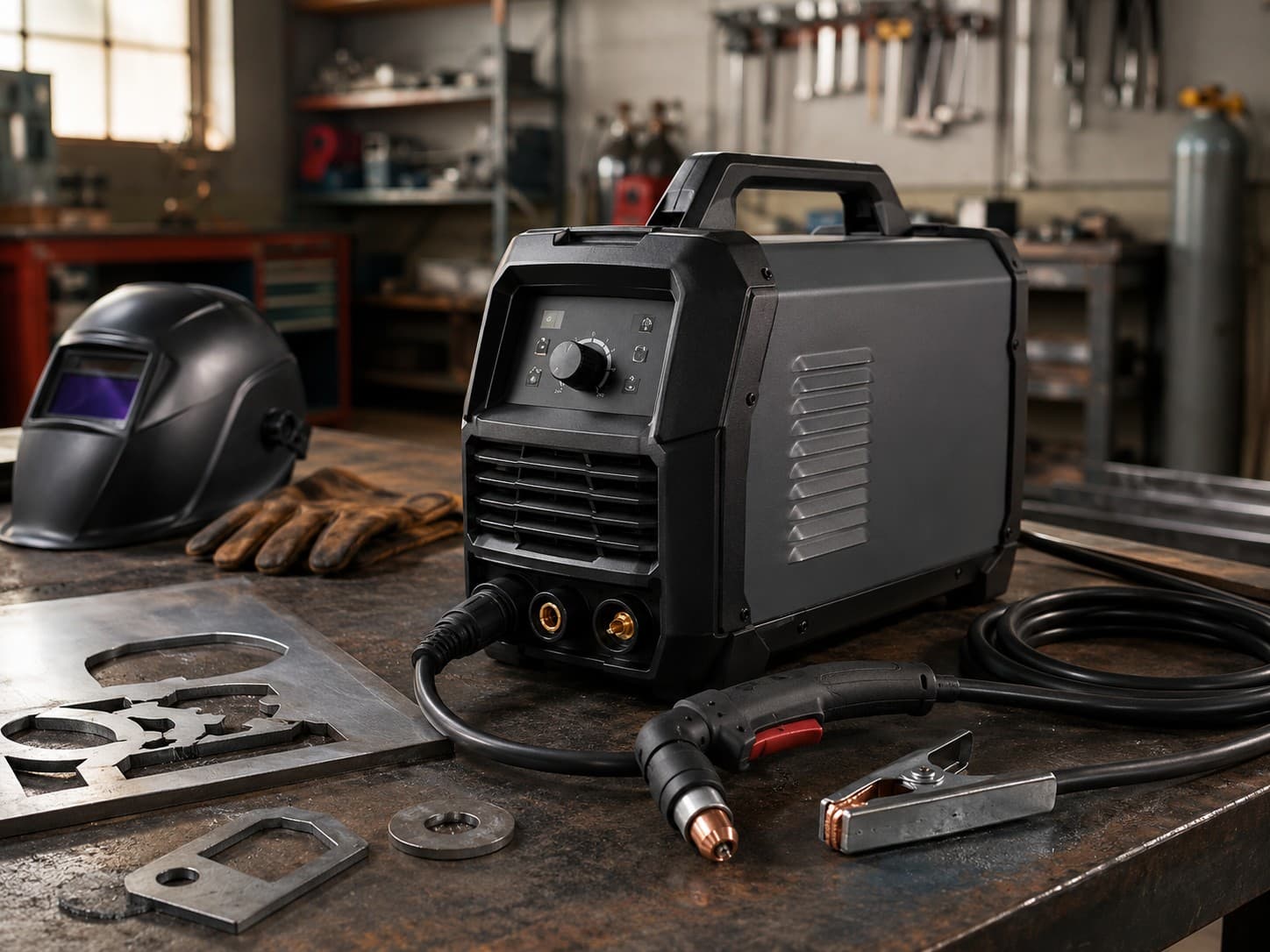
Cut thickness is the number every listing shouts the loudest, and it's the number most often stretched. Manufacturers quote three different figures — rated (clean) cut, quality cut, and sever cut — and the biggest one on the box is usually the sever cut, which produces a slow, ugly, dross-covered edge you'll spend an hour grinding. Shop the rated cut, not the headline.
- Under 1/4 in — The sweet spot for sheet metal: auto body panels, HVAC ductwork, thin-gauge metal art, and light brackets. Machines in this class are compact, cheap to run, and often work on standard household power. If everything you touch is 16-gauge to 1/8 in, buying bigger just means buying heavier.
- 1/4 in to 1/2 in — The most useful all-around range for home garages and small fab shops. This covers plate steel, angle iron, trailer frames, and thick brackets. It's the range where most 45–60 A dual-voltage machines live, and where price-to-capability peaks for the average buyer.
- 1/2 in to 3/4 in — Serious fabrication territory. You're now cutting structural steel, heavy plate, and equipment repair material. Expect a 220 V requirement, a real air compressor, and a machine that costs more than a weekend project usually justifies.
- 3/4 in to 1 in — Industrial and heavy-repair work: excavator buckets, thick shafts, salvage and demolition. Cuts at this depth are slow, hot, and hard on consumables. Verify whether the number quoted is a rated cut or a sever cut before you believe it.
- 1 in to 1-1/2 in — Professional heavy plate work, typically requiring 80–100 A and single- or three-phase industrial power. These machines are bought for a specific job, not for general utility.
- Over 1-1/2 in — The realm of true industrial cutters, usually paired with CNC tables or heavy salvage operations. At this level, gouging and sever cutting matter as much as clean cutting, and consumable cost per foot becomes a line item in your budget.
Pick a machine rated to cut roughly twice the thickness you work with most often. A cutter running at the very edge of its capacity cuts slowly, burns consumables fast, and leaves dross; the same cut on a machine with headroom is fast, clean, and nearly grind-free.
Amperage
Amperage is the raw muscle behind the arc — it determines how thick you can cut, how fast, and how clean. Just as important is the duty cycle attached to that amperage: a "60 A" machine rated at 60 percent duty cycle can cut six minutes out of ten before it needs to cool. Always read the amperage and the duty cycle together, because one without the other is marketing.
- Under 30 A — Light-duty sheet metal machines. Excellent for HVAC, body panels, and detailed art work where a narrow kerf and fine control beat brute force. They run on standard household outlets and are gentle on consumables, but they'll stall on anything approaching 1/4 in.
- 30 A to 45 A — The most popular home-shop bracket. Handles most DIY and garage work up to about 1/2 in, generally runs on 220 V (many are dual voltage), and keeps the machine light enough to carry with one hand. This is where the majority of Amazon's best-sellers live.
- 45 A to 60 A — The workhorse range for serious hobbyists and small fabrication shops. Fast, clean cuts through 1/2 in with headroom left over, and enough power for occasional gouging. If you're buying one machine to do everything, this is usually it.
- 60 A to 80 A — Production-oriented power for shops cutting thick plate daily. Look hard at the duty cycle here; a high-amp machine with a 30 percent duty cycle is a weekend cutter wearing a work shirt.
- 80 A to 100 A — Heavy industrial cutting and CNC table work. These demand serious incoming power and a compressor that can genuinely keep up — undersized air will destroy consumables faster than any other mistake.
- Over 100 A — Dedicated industrial equipment for thick plate, heavy salvage, and high-throughput CNC operations. Rarely bought casually, and rarely a mistake when it is bought.
Match amperage to the material you cut on your worst day, not your average one. And treat duty cycle as a hard spec, not a footnote — thermal shutdown mid-cut is how good plate turns into scrap.
Voltage
Voltage decides whether your new cutter is a tool or a paperweight. Before you add anything to the cart, walk out to your garage and look at what's actually on the wall — many buyers discover the 240 V requirement after the box arrives. Dual-voltage machines have become the default for good reason.
- 110V — Runs on a standard household outlet with an adapter, no electrician required. Perfect for apartment shops, mobile work, and thin material, but expect a real drop in cutting capacity — a machine that does 1/2 in on 240 V may only manage 1/4 in on 110 V. Check the breaker rating too; many need a dedicated 20 A circuit.
- 120V — Functionally the same as 110 V (the terms are used interchangeably in listings), and carries the same trade-offs: ultimate convenience, real capacity limits. Great for HVAC techs, body shops, and anyone who cuts thin metal in places without a welding outlet.
- 220V — The standard for serious cutting. Unlocks a machine's full rated thickness and duty cycle. You'll need a proper outlet — usually NEMA 6-50 or 6-20 — and possibly an electrician, so budget for that before you budget for consumables.
- 240V — Again, the same circuit as 220 V by another name. If a listing says dual voltage 110/220 V or 120/240 V, you're getting flexibility to run light work anywhere and heavy work at the shop, which is the best of both worlds for most buyers.
- 480V — Industrial three-phase power, found in production shops and manufacturing plants, not in home garages. If you have to ask whether you have 480 V, you don't.
For most people the smart buy is a dual-voltage machine with an included adapter — full power when you're plugged into the shop, portable capability when you're not. Just confirm the required breaker amperage before you commit, since the outlet is the expensive part.
Air Source
Plasma cutting is half electricity and half air, and the air side is where most cheap machines go to die. Your cutter needs dry, clean, steady compressed air at a specific pressure and flow rate; anything less means blown consumables, wandering arcs, and dross. This spec deserves far more attention than it usually gets.
- Built-In Air Compressor — The all-in-one option: plug it in and cut, no shop compressor needed. Wonderful for jobsites, small spaces, and anyone without a 60-gallon tank in the corner. The trade-offs are real, though — built-in compressors add weight, produce warm and often moist air, limit you to thinner material, and typically restrict duty cycle since the compressor must keep up in real time.
- External Air — The standard for capability. Connects to your shop compressor and delivers cooler, drier, higher-volume air, which means longer consumable life and cleaner cuts. Check the required CFM at PSI on the listing — typically somewhere around 3.5 to 7 CFM at 60 to 90 PSI — and make sure your compressor actually delivers it continuously, not just in bursts. Add a water separator and inline dryer; moisture is the single most common cause of poor cuts and premature consumable failure.
If you already own a decent compressor, go external — you'll cut better, cut longer, and spend less on tips. If you don't, be honest about whether you'd rather buy a built-in machine now or a compressor you'll use for the next twenty years anyway.
Arc Start Type
How the arc ignites affects consumable life, cut quality on rough material, and whether your machine gets along with the electronics around it. This is one of the more technical specs on the list, and one of the most consequential — especially if a CNC table is anywhere in your future.
- Non-Touch Pilot Arc — The premium feature. A pilot arc lets you start cutting without the tip contacting the workpiece, which dramatically extends consumable life and makes cutting rusty, painted, or expanded metal far easier. If you're deciding between two machines and one has a pilot arc, that's usually the tiebreaker.
- Blowback Pilot Arc — A pilot arc created mechanically, by internal parts separating under air pressure, rather than by high-frequency energy. You get pilot arc benefits without HF interference, making it the ideal pairing for CNC tables and electronics-heavy shops. It's the modern standard on quality machines.
- High Frequency — Uses a burst of high-frequency energy to ionize the air and start the arc. Effective and long-proven, but the HF pulse can interfere with nearby electronics, CNC controllers, computers, and even garage door openers. Reliable in isolation, troublesome in company.
- Non-HF — Any start method that avoids high-frequency emission. Essential if you plan to run a CNC table, and generally friendlier to everything else plugged in around you.
- Contact Start — The tip must touch the workpiece to strike the arc. Simple, cheap, no interference, but it wears consumables faster and struggles on grating, rust, and painted surfaces where contact is inconsistent.
- Drag Cut — Lets you rest the tip directly on the metal and drag it along the cut line, which is genuinely easier for beginners and helps maintain a consistent standoff. Great for control and clean lines on thin material, though it does consume tips faster than non-touch cutting.
For most buyers, a blowback pilot arc is the ideal target: easy starts, long consumable life, no interference, and CNC compatibility down the road. Contact and drag start machines are perfectly usable for occasional light work — just plan on buying tips more often.
Torch Type
The torch model on a listing tells you more than it looks like it does. It signals the machine's amperage class, how ergonomic the cutting will feel, and — most importantly — how easily and cheaply you'll find replacement consumables three years from now. Consumables are a recurring cost; the torch determines that cost.
- PT31 — The classic budget contact-start torch, typically paired with 30–40 A machines. Consumables are everywhere and dirt cheap, but it's a contact-start design, so tip life is shorter and it can struggle on rough or coated material.
- AG60 — Probably the most common torch on affordable pilot-arc machines up to about 60 A. Consumables are inexpensive and widely stocked on Amazon, and the pilot arc handles rust and expanded metal well. A safe, practical choice for the average buyer.
- IPT40 — A compact, comfortable torch for roughly 40 A machines, favored for detail work and tight access. Good ergonomics and generally decent consumable availability.
- IPT60 — The 60 A sibling: a bit more capable, still comfortable, and common on mid-range machines. A solid middle-ground option for general shop work.
- P80 — A heavier 80 A torch built for thicker plate. Bulkier in hand and less suited to delicate work, but it handles sustained cutting on heavy material without complaint.
- SG55 — A widely used 50–55 A torch found on many imported machines. Consumables are cheap and plentiful, though quality varies significantly by supplier — buy from the machine's manufacturer when you can.
- PT80 — A common 80 A workhorse torch for fabrication-class machines. Robust, well-supported, and a familiar sight in production shops.
- PT100 — Heavy industrial torch for 100 A and up. Built for thick plate and long cuts; overkill for anything a home shop is likely to do.
Before buying, search Amazon for that torch's consumable kits and check price and availability. A cheap machine with an obscure proprietary torch stops being cheap the first time you need tips and electrodes and can only get them from one seller.
Cutting Modes
Not every cut is a straight line through clean plate. Cutting modes describe the specific jobs a machine is designed to handle, and they're a fast way to tell whether a cutter fits your actual work or just the marketing photo of your work.
- Plate Cutting — The baseline: straight, clean cuts through solid sheet and plate. Every plasma cutter does this. What varies is speed, edge quality, and how much dross you'll grind off afterward.
- Expanded Metal — Cutting grating, mesh, and perforated material where the arc repeatedly loses contact with the workpiece. This is where a pilot arc earns its price — contact-start machines constantly stutter and restart, chewing through consumables.
- Gouging — Removing material without cutting all the way through, used to back out bad welds, remove rivets, or prep joints. It demands higher amperage and specific gouging consumables, and it's brutally hard on the torch. Verify the machine actually supports it rather than assuming.
- Marking — Using a very low-amperage arc to scribe layout lines rather than cut. Mostly relevant to CNC users who want to mark bend lines or part numbers before cutting them out.
- Rust Removal — More precisely, the ability to cut cleanly through rusted, painted, or dirty material without arc instability. Pilot-arc machines handle it comfortably; contact-start machines fight you for every inch.
- Bevel Cutting — Cutting at an angle to prepare edges for welding. It's largely a matter of technique and torch guide accessories rather than a machine feature, but a stable arc and good standoff control make it far easier.
If your work is straight cuts through clean plate, almost any machine will satisfy. The moment grating, rust, or weld repair enters the picture, a pilot arc and adequate amperage stop being luxuries.
Features
This is where listings pile on the bullet points, and where a little discernment saves real money. Some of these features meaningfully change how the machine performs; others are there to fill out a bulleted list. Here's which is which.
- Portable — Modern inverter machines can weigh well under 30 pounds, which genuinely matters if you're carrying it to a jobsite, up a ladder, or out to the back forty. Just remember that "portable" says nothing about power, and a built-in compressor adds weight right back.
- LED Display — Shows amperage, air pressure, and fault codes at a glance. Not glamorous, but it turns guesswork into setting a number, and it's genuinely useful for repeating a cut you got right last week.
- Air Pressure Sensor — Warns you or shuts the machine down when air pressure drops out of range. Since low air is the leading cause of destroyed consumables and ruined cuts, this quietly saves you money. An underrated feature.
- Built-In Air Regulator — Lets you dial in exact pressure at the machine instead of fighting with your compressor across the shop. Usually paired with a water trap, which is the part that really matters — moisture is the enemy.
- App Control — Bluetooth or Wi-Fi adjustment of settings from your phone. Mildly convenient, occasionally handy on a CNC setup, and rarely worth paying a premium for. Nice to have, never a deciding factor.
- 2T/4T — Trigger modes. 2T means the arc runs only while you hold the trigger; 4T lets you press and release to keep the arc running, then press again to stop. On long cuts, 4T saves your hand real fatigue.
- Post Flow — Air continues flowing for a few seconds after the arc stops, cooling the torch and consumables. It measurably extends tip life and costs nothing extra. Look for it.
- CNC Ready — Includes a CNC interface port and, ideally, a non-HF start so the controller doesn't get scrambled. If a plasma table is anywhere in your five-year plan, buy this now — retrofitting isn't practical.
- Multi-Process Combo — Machines that combine plasma cutting with TIG and/or stick welding in one box. Outstanding value and a space-saver for home shops, though a combo unit rarely matches a dedicated machine at any single process. For a garage that does a bit of everything, that's a fair trade.
Prioritize the unglamorous features — post flow, air pressure sensing, a built-in regulator with a water trap — because those are the ones that protect consumables and cut quality. App control and cosmetic extras should never break a tie between two machines.
Use Case
The fastest way to find the right machine is to skip the spec sheet for a moment and be honest about what you'll actually cut, where, and how often. Each of these profiles points to a different combination of the specs above.
- DIY — Occasional projects, mixed materials, mostly under 1/4 in. Prioritize dual voltage, low weight, and a modest price. A 40–45 A machine covers nearly everything you'll encounter.
- Beginner — Look for drag-cut capability, a clear digital display, and forgiving settings. The goal is a machine that lets you learn technique rather than fight the equipment. Simplicity beats specs.
- Home Garage — The 45–60 A dual-voltage pilot-arc machine is the classic answer: enough power for 1/2 in plate, light enough to move, and versatile enough for whatever the weekend brings.
- Auto Body Repair — Thin sheet metal, tight spaces, precision over power. A low-amperage machine with fine control and a compact torch is ideal; a big industrial cutter is the wrong tool entirely.
- Metal Art — Detail work, thin stock, and lots of curves. Narrow kerf, a comfortable lightweight torch, and low-amp stability matter more than maximum thickness. Pilot arc helps enormously with intricate work.
- Fabrication — Daily cutting, varied thickness, real duty cycle demands. Target 60 A or more, 220 V, external air, and gouging capability. Buy for the duty cycle, not the headline thickness.
- Farm & Ranch — Rusty, painted, and unpredictable material, often far from a proper outlet. A pilot arc handles the rust, portability handles the distance, and a built-in compressor may be worth its weight if there's no air in the barn.
- HVAC — Thin ductwork, job-to-job portability, and 110 V outlets. A lightweight low-amp machine, ideally with a built-in compressor, is the whole answer.
- Industrial — Thick plate, high throughput, three-phase power, and CNC integration. Duty cycle, consumable cost per foot, and manufacturer support outweigh purchase price.
- Jobsite — Portability, durability, and power flexibility. Dual voltage, a built-in compressor or generator compatibility, and a rugged case matter more than a marginal thickness rating. Verify generator compatibility explicitly if that's your power source.
Identify your two most common jobs and buy for those, with a little headroom for the third. Buying for the one heavy cut you might make someday usually means living with a heavy, expensive machine for all the cuts you actually make.
Brand
Brand in this category is less about prestige than about two practical things: whether consumables will still be easy to find in three years, and whether anyone answers the phone when something breaks. The market splits cleanly into premium American manufacturers and value-focused imports, and both have legitimate places in a garage.
- Hypertherm — The industry benchmark. Exceptional cut quality, outstanding consumable life, and the best support in the business. You pay significantly more, and professionals cutting daily generally consider it money well spent. Overkill for a weekend hobbyist.
- Miller — A premium American brand with excellent build quality and dealer support. The Spectrum line is a fixture in serious shops. Strong resale value and consumables available essentially anywhere.
- Lincoln Electric — Another blue-chip name with a long professional pedigree and extremely broad parts availability. Reliable, well-supported, and priced accordingly.
- Hobart — Positioned as a more accessible entry into premium-tier quality, backed by the same manufacturing lineage as Miller. A good bridge between budget imports and full professional gear.
- PrimeWeld — A standout in the value tier, with a strong reputation for customer service and warranty support that punches well above the price. A frequent recommendation for home shops that want reliability without the premium tag.
- Everlast — Long-established mid-tier brand offering good specs per dollar and a wide product range, including plenty of multi-process combos. A solid middle option.
- Eastwood — Popular with the automotive and restoration crowd, with machines tuned toward body panel and sheet metal work. Good documentation and accessible support.
- Forney — A well-known name in home and farm shops, offering straightforward, dependable machines without a lot of fuss. Easy to find, easy to live with.
- Lotos — One of the original Amazon budget success stories. Inexpensive, widely available, and genuinely capable for light work; support and consumable consistency are the trade-offs.
- YesWelder — A very popular value brand with strong online presence and aggressive pricing. Good specs for the money, with an active consumable supply on Amazon.
- ArcCaptain — A newer value brand that has built a following with feature-heavy, well-reviewed budget machines. Worth a look if you want modern features at an entry price.
- Herocut — Budget-focused imports aimed at light-duty and hobby users. Fine for occasional work; not built for daily production.
- Vevor — The deepest end of the budget pool. The price is hard to argue with and quality control is inconsistent, so treat it as a low-stakes entry point rather than a long-term investment.
- Reboot and Bestarc — Additional import brands competing on price and features. Read recent reviews carefully and check consumable availability before committing.
If you cut for a living, buy premium and stop thinking about it — the consumable savings and support alone justify the difference. If you cut occasionally, a well-reviewed value brand with a common torch type and a real warranty will serve you honestly for years, provided you feed it clean, dry air.