TIG Welder Buying Guide
Current Type
The single most important decision when buying a TIG welder is the type of current it produces, because it determines what metals you can actually weld. Get this wrong and no amount of extra features will help you.
- AC/DC — This is the versatile choice. AC (alternating current) is required for welding aluminum and magnesium because it breaks up the tough oxide layer on those metals. DC (direct current) handles steel, stainless, and most other metals. If you want to weld aluminum at all, you need AC/DC, full stop.
- DC Only — A DC-only machine welds steel, stainless steel, copper, titanium, and chrome moly beautifully, and these units are often cheaper and lighter. The catch is that they cannot weld aluminum. For many hobbyists and fabricators who never touch aluminum, DC-only is a smart way to save money.
If aluminum is anywhere in your future, buy AC/DC and don't look back. If you're strictly a steel-and-stainless welder, a DC-only machine gives you cleaner performance for less cash.
Input Voltage
Voltage decides where you can actually plug the welder in and how much power it can pull. This is a practical question about your shop's wiring as much as the machine itself.
- 110V — Runs off a standard household outlet, perfect for garages without special wiring. The tradeoff is lower maximum amperage, so it suits thinner materials.
- 220V — Delivers far more power for thicker metal and higher output, but needs a dedicated 220V outlet like the kind used for a dryer.
- Dual Voltage — Switches between 110V and 220V, giving you household convenience for light work and full power when you have the right circuit. This is the sweet spot for most buyers.
- 3 Phase — Industrial machines requiring commercial power infrastructure. Unless you're outfitting a professional shop, skip it.
Dual voltage offers the most flexibility for the widest range of situations. Check the outlets you actually have first, because a powerful 220V-only machine is useless if you can't plug it in.
Max Amperage
Amperage is the raw welding power on tap, and it directly controls how thick a piece of metal you can join. More amps means thicker material, but also a heavier, pricier machine.
- Under 140 A — Suited to thin sheet metal and light hobby work. Fine for delicate jobs but limiting if you branch out.
- 140 A to 179 A — A comfortable entry-level range for auto panels, light fabrication, and general home use.
- 180 A to 224 A — The versatile mid-range that covers the majority of DIY and semi-professional projects, including moderately thick steel.
- 225 A to 249 A — Strong output for heavier fabrication and thicker plate, common in serious hobbyist machines.
- 250 A to 500 A — Professional and industrial territory for thick structural steel and continuous heavy work.
A rough rule is one amp per thousandth of an inch of material thickness. Buy a bit more amperage than you need today, since the headroom is cheap insurance against future projects.
Brand
Brand reputation reflects real differences in reliability, support, and parts availability, which matter when a machine needs service years later. On Amazon you'll find both established names and value-focused newcomers, so knowing the landscape helps you avoid a listing you'll regret.
- Miller and Lincoln Electric — The premium American heavyweights, known for top-tier quality, durability, and support at a correspondingly higher price.
- ESAB — A respected global brand offering professional-grade machines with strong engineering.
- Hobart — A trusted mid-range name popular with serious hobbyists and small shops.
- Everlast — A well-regarded value brand that packs professional features into affordable machines, a longtime enthusiast favorite.
- PrimeWeld — Has built a strong reputation for reliable, feature-rich welders at competitive prices with good customer support.
- YesWelder and ArcCaptain — Popular budget-friendly brands offering surprising capability for the money, ideal for beginners.
- Vevor, Lotos, and HitBox — Very affordable entry points that get the job done for light use, though long-term support and parts can be less certain.
Premium brands justify their cost with reliability and service if you weld heavily, while value brands deliver remarkable capability for hobby and home use. Whatever tier you pick, read recent buyer reviews and confirm replacement consumables are easy to find before committing.
Accessories
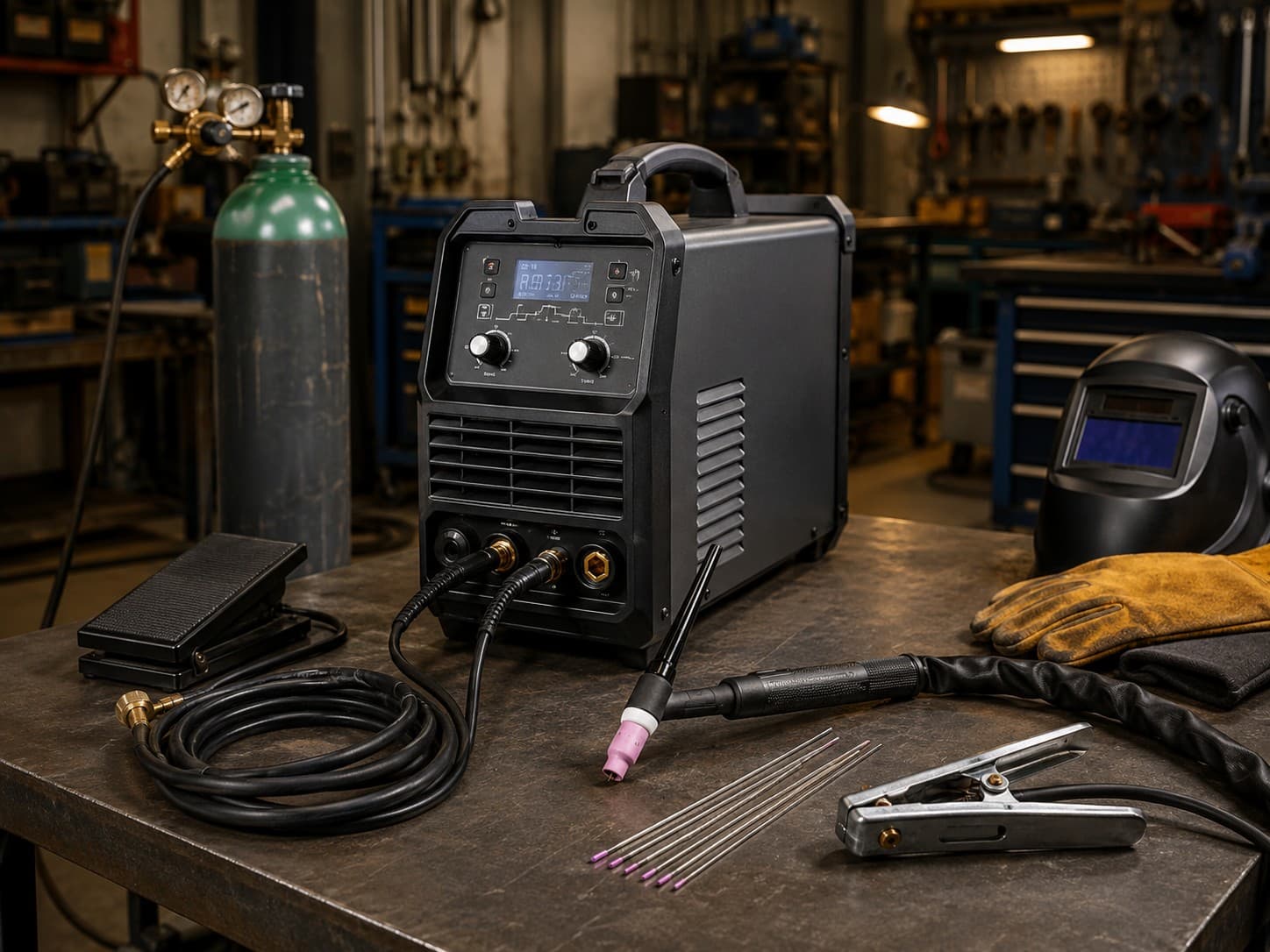
A welder is only useful with the right accessories, and what's in the box directly affects the true cost of your purchase. A cheaper machine with nothing included can easily end up costing more once you buy the extras.
- TIG Torch — The core tool that delivers the arc; check its quality and amperage rating.
- Foot Pedal — Lets you control amperage in real time with your foot, essential for fine TIG work and heat control.
- Ground Clamp — Completes the circuit, and a solid one ensures a stable arc.
- Gas Regulator and Gas Hose — Control and deliver shielding gas from your tank; often not included, so verify.
- Tungsten Electrodes — The non-consumable tips that create the arc; a starter assortment is handy.
- Consumables Kit — Extra collets, cups, and gaskets that keep you welding without ordering parts.
- Welding Gloves and Welding Helmet — Basic safety gear, though bundled versions are often lower quality.
- Welding Cart — A rolling stand for mobility around the shop, a nice bonus when included.
A foot pedal and TIG torch are must-haves, so confirm they're included or budget for them separately. Bundled gloves and helmets are often worth upgrading, and always check whether the gas regulator comes in the box before assuming the price is complete.
Duty Cycle
Duty cycle tells you how long the welder can run before it needs to cool down, expressed as a percentage of a ten-minute window. It's easy to overlook, yet it separates a machine that keeps up with your work from one that constantly makes you wait.
- Under 30% — Welds under three minutes out of every ten before pausing. Acceptable for short tacks and light hobby use only.
- 30% to 39% — Entry-level performance that works for intermittent projects but frustrates during longer beads.
- 40% to 59% — A solid middle ground for most home and small-shop welders doing steady but not continuous work.
- 60% to 79% — Serious performance that keeps up with extended fabrication sessions.
- 80% to 100% — Near-continuous operation built for professional and production environments.
Always check what amperage the rating is measured at, because a "60% duty cycle" at low amps means much less at full power. Higher is better, but honestly assess how long your welds actually run before overpaying for capacity you won't use.
Features
This is where welders differentiate themselves, and knowing these terms helps you tell genuinely useful capabilities from spec-sheet filler. Some are essential, others are pleasant extras.
- Pulse — Rapidly cycles current between high and low to control heat, reducing warping and producing that stacked-dime look. Excellent for thin metal and clean results.
- AC Balance Control — Adjusts the ratio of cleaning to penetration on aluminum, a must-have for quality aluminum welds.
- Square Wave — Refers to the AC waveform shape, giving a more stable, cleaner arc on aluminum than older designs.
- 2T/4T — Controls trigger behavior; 2T requires holding the trigger, while 4T lets you lock it on for long welds without hand fatigue.
- IGBT Inverter — Modern technology that makes the machine lighter, more efficient, and more stable than old transformer designs. Essentially standard now and worth having.
- Memory Preset — Saves your dialed-in settings so you can recall them instantly for repeat jobs.
- Synergic Control — Automatically sets parameters based on material and thickness, taking the guesswork out for beginners.
- Hot Start — Briefly boosts amperage at the start to establish the arc quickly and cleanly.
- App Control — Adjusts settings and presets through a smartphone app, a modern convenience on some newer machines.
Prioritize pulse, AC balance control, and 2T/4T if you want real versatility, and treat IGBT inverter as a baseline expectation. App control and memory presets are nice conveniences rather than dealbreakers, so weigh them against the features that actually improve your welds.
Welding Processes
Many TIG welders double as multiprocess machines, letting one unit do several jobs. This can save money and bench space, but only if you'll actually use the extra modes.
- Stick — Nearly every TIG welder also does stick (SMAW), a rugged process great for outdoor work, thick metal, and dirty or rusty material.
- MIG — Some multiprocess units add MIG, which is faster and easier for production and general fabrication.
- Flux Core — A wire-fed process that works without shielding gas, handy for outdoor welding where wind would blow gas away.
- Plasma Cutter — Certain combo machines include plasma cutting for clean, fast metal cuts, adding real shop value.
- Spool Gun Compatible — Indicates the machine can run a spool gun for feeding aluminum MIG wire, relevant if you MIG aluminum.
- Multiprocess — The umbrella term for a machine combining several of these processes in one box.
A multiprocess machine is a genuine value if you'll use the extra modes, but don't pay for MIG and plasma capability you'll never touch. A dedicated TIG welder often delivers better pure TIG performance than a jack-of-all-trades unit.
Metals
Not every welder handles every metal, and this often circles back to the current type. Knowing what you'll weld tells you what machine to buy.
- Aluminum — Requires an AC/DC machine and benefits greatly from AC balance control and high frequency start.
- Stainless Steel — Welds cleanly on DC and is a staple for food-grade, marine, and decorative work.
- Mild Steel and Carbon Steel — The everyday workhorses of welding, handled easily by any DC-capable TIG machine.
- Copper and Brass — Weldable on DC but demand higher heat due to their conductivity.
- Titanium — Weldable with TIG on DC but requires careful gas shielding to prevent contamination.
- Magnesium — Like aluminum, needs AC current to weld properly.
- Cast Iron — Trickier to weld and usually requires specific technique and filler, but possible with TIG.
- Chrome Moly — Popular in motorsports and aerospace, weldable on DC and prized for strength.
Make a list of the metals you'll realistically weld before shopping, since that single list often dictates whether you need AC/DC or can save with DC-only. When in doubt, AC/DC covers the widest range of materials.
Arc Start
How the arc ignites affects weld cleanliness, contamination risk, and ease of use, especially on delicate or reactive metals. The starting method matters more than beginners expect.
- High Frequency Start — Initiates the arc without the tungsten ever touching the metal, giving a clean, contamination-free start. It's the gold standard for aluminum and precision work but can interfere with nearby electronics.
- Lift Start — You lightly touch the tungsten to the metal and lift it away to ignite the arc, producing minimal contamination and no electrical interference. It's reliable, simple, and great for jobsites near sensitive equipment.
- Scratch Start — The most basic method, where you drag the tungsten like striking a match. It's cheap and dependable but risks tungsten contamination and a messier start.
High frequency is ideal for clean, precise work, while lift start is a practical and forgiving alternative. Scratch start is the budget option, and a machine offering multiple start types gives you welcome flexibility.