Published on Sunday, August 10, 2025
Turntable Buying Guide
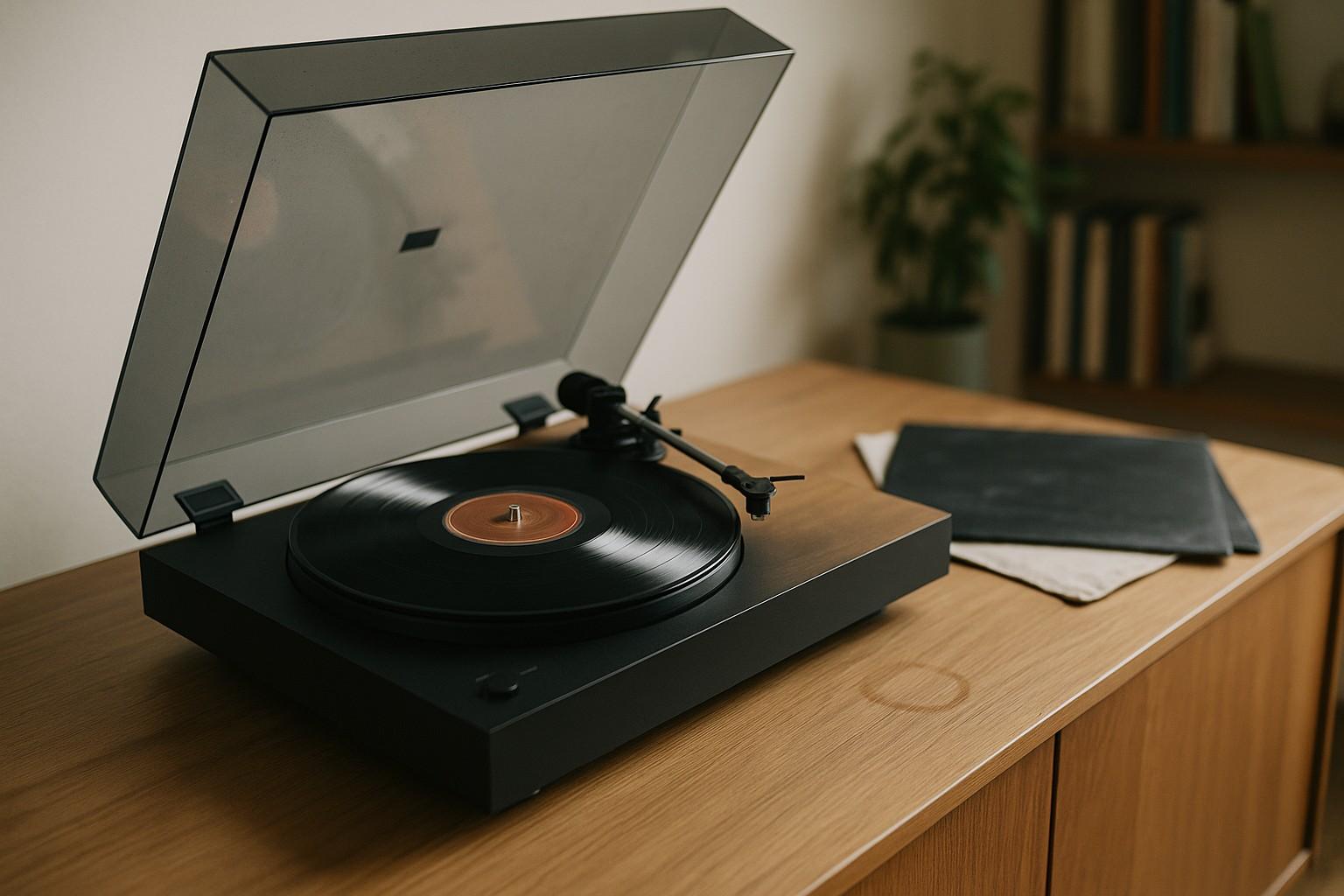
Intro
Welcome to the world of vinyl! Choosing your first turntable can feel overwhelming with all the technical terms and features. This guide will break down the most important attributes to help you understand what they mean, what you need, and how to find the perfect turntable for your needs.
Turntable RPM
RPM stands for "Revolutions Per Minute" and refers to how fast the turntable's platter spins. Different types of records are designed to be played at different speeds. If you play a record at the wrong speed, the music will sound comically fast and high-pitched or slow and deep.
RPM: This is the most common speed. It's used for full-length, 12-inch albums, also known as LPs (Long Play). Virtually every modern turntable will support this speed.
- 45 RPM: This speed is for 7-inch "single" records, which typically have one song per side. It's also used for some 12-inch EPs (Extended Play) and audiophile-quality albums that spread the music across more discs for better sound quality. Most turntables will also have this speed setting.78 RPM: This is a much older and rarer speed used for shellac records made before the mid-1950s. These records are thicker, heavier, and more brittle than modern vinyl.
For 99% of users, a turntable that plays at and 45 RPM is all you will ever need. Only seek out a model with 78 RPM capability if you have a specific collection of these very old records. Crucially, playing 78s requires a special, larger stylus (needle). Using a standard stylus on a 78 RPM record will damage both the record and the stylus.
Turntable Drive Type
This describes how the motor's power is transferred to the platter to make it spin. The two methods have different characteristics that affect sound quality and performance.
- Belt Drive: The motor is located off to the side and is connected to the platter by a rubber belt. This design is excellent at isolating the platter from the motor's vibrations, which results in cleaner, more accurate sound. The belt acts as a shock absorber. This is the preferred type for most home listening and audiophile setups. The downside is the belt can wear out and will need to be replaced every few years (a simple and inexpensive task).
- Direct Drive: The motor is situated directly beneath the platter, spinning it without a belt. This system provides very accurate speed stability and high torque, meaning it gets up to speed almost instantly and is resistant to slowing down from friction. This makes it the non-negotiable choice for DJs who need to scratch and back-cue records. The potential downside is that some motor vibrations can be transferred to the platter and picked up by the stylus, though modern engineering has minimized this issue in quality models.
If your primary goal is listening to music at home, a Belt Drive turntable is generally the better choice for superior sound quality. If you plan to DJ, a Direct Drive turntable is essential.
Turntable Operation
This determines how much manual effort is required from you to start and stop playing a record.
- Manual: You are in complete control. You must physically lift the tonearm, place the stylus onto the beginning of the record, and lift it off again when the side is finished. This offers a more tactile, engaged experience but requires a steady hand and means you have to get up to stop the needle from spinning endlessly in the run-out groove.
- Semi-Automatic: This is a popular compromise. You still manually place the tonearm on the record to start playing, but when the record ends, the turntable automatically lifts the tonearm and often returns it to its rest, shutting off the motor. This prevents unnecessary wear on your stylus if you can't get to it right away.
- Fully Automatic: This is the most convenient option. With the press of a button, the turntable will automatically lift the tonearm, place it on the record, and return it to its rest when the side is over. This is perfect for beginners, those with shaky hands, or anyone who values convenience and wants to minimize the risk of accidentally scratching a record.
For beginners, a Fully Automatic or Semi-Automatic turntable offers great peace of mind and protects your equipment. Manual turntables are favored by purists who enjoy the ritual, but a semi-automatic model provides the best of both worlds for most listeners.
Key Features
These are essential adjustments that allow you to optimize your turntable's performance, resulting in better sound and longer life for both your stylus and your vinyl collection.
- Adjustable Counterweight: This is the cylindrical weight at the back end of the tonearm. Its job is to balance the arm perfectly so you can set the correct vertical tracking force (VTF)—the downward pressure the stylus exerts on the record. Too much pressure wears out your records and stylus; too little can cause skipping and poor sound. This is one of the most important features for a quality turntable.
- Anti-Skate: As a record spins, there's a natural physical force that wants to pull the tonearm toward the center of the record. Anti-skate applies a small amount of opposing outward force to keep the stylus perfectly centered in the groove. This ensures even wear on the stylus and prevents distortion.Pitch Control: This is usually a slider that allows you to make fine adjustments to the platter's speed (e.g., ±10%). While it can be used to correct speed inaccuracies, its primary use is for DJs to beatmatch two songs together. For casual listening, it's a non-essential but occasionally nice-to-have feature.
Do not buy a turntable without an Adjustable Counterweight and Anti-Skate if you are serious about your records. These two features are the key difference between a "toy" player that can damage your vinyl and a proper hi-fi component. Pitch control is only a must-have for aspiring DJs.
Connectivity
This determines how your turntable can connect to speakers, amplifiers, or your computer. This is a crucial consideration for a beginner.
- Preamp (Built-in Phono Preamp): A turntable cartridge produces a very weak electrical signal called a "PHONO" signal. It needs to be amplified and equalized before it can be played through modern speakers. A built-in preamp (or "phono stage") does this for you, outputting a standard "LINE LEVEL" or "AUX" signal. This allows you to plug the turntable directly into powered speakers or any stereo receiver's AUX input.
- Bluetooth: A turntable with Bluetooth can wirelessly stream the audio to a Bluetooth-enabled speaker or headphones. This is incredibly convenient for a wire-free setup. However, the audio signal must be compressed for wireless transmission, which results in a loss of some sound quality compared to a wired connection.USB: A USB output allows you to connect the turntable directly to a computer. This is specifically for one purpose: digitizing your vinyl collection by recording the audio into a program like Audacity to create MP3s or other digital files.
For maximum ease of use, look for a turntable with a built-in, switchable preamp. The "switchable" part is a bonus, allowing you to turn it off if you later decide to buy a higher-quality external preamp. Bluetooth is great for convenience over absolute quality. Only prioritize a USB output if your main goal is to make digital copies of your records.
Cartridge Setup
The cartridge is the component on the end of the tonearm that holds the stylus (needle). It's responsible for turning the physical grooves of the record into an electrical signal.
- Pre-installed (Replaceable): This is the ideal setup for most users. The turntable comes ready to play out of the box, but you have the ability to replace the stylus when it wears out (typically after 500-1000 hours of play) or upgrade the entire cartridge to a better one down the line. This offers the best of both worlds: convenience now and an upgrade path for the future.
- Pre-installed (Not Replaceable): This is a major red flag and is common on the cheapest, "suitcase-style" all-in-one record players. Because the stylus wears out over time, an inability to replace it means the entire turntable becomes a record-damaging paperweight once the stylus is worn.
- No Cartridge: This option is for experienced audiophiles who want to select and install their own high-end cartridge from the start. This is not recommended for beginners.
Only consider turntables with a Pre-installed (Replaceable) cartridge. It is the single most important feature for ensuring the longevity of both your turntable and your precious record collection. Avoid non-replaceable cartridges at all costs.
Use Case
Thinking about how you plan to use your turntable will help you prioritize the features above.
- Casual Listening: You want to easily play records in your living room or bedroom with minimal fuss. Prioritize: Fully-Automatic operation, a built-in preamp, and perhaps Bluetooth for easy connection to a portable speaker.
- Stereo / Hi-Fi Setup: You are building a dedicated sound system for high-quality listening. Prioritize: Belt Drive, an Adjustable Counterweight and Anti-Skate, and a Replaceable Cartridge.
- Digitizing Vinyl Collection: Your primary goal is to create digital backups of your records. The one essential feature is a USB output.
- DJ: You plan to mix, scratch, and perform with your records. The non-negotiable features are Direct Drive and Pitch Control. A rugged build and manual operation are also standard.
Be honest about your primary goal. A turntable built for a DJ is not ideal for an audiophile, and a simple Bluetooth player won't satisfy someone looking to build a hi-fi system. Match the features to your ambition.
Style
After you've sorted out the technical specs, you can choose a turntable that matches your personal aesthetic and home décor.
- Vintage: A retro look, often mimicking the designs of the 1960s and 70s with classic knobs and a nostalgic feel.
- Modern: A sleek, minimalist design, typically in black, white, or silver, with clean lines and an understated presence.
- Hi-Fi: A "form-follows-function" aesthetic. These turntables often look technical and precise, with an emphasis on the mechanical components. This style heavily overlaps with the Modern look.
- Wood Finish: A classic and popular style that uses a wood plinth (the base of the turntable). This can range from a light oak to a dark walnut and can be incorporated into both vintage and modern designs for a warm, organic look.
This is all about you! Once you have a list of turntables that meet your technical needs, pick the one you'll be happiest to see every day. A great-looking turntable is more likely to be a treasured part of your home.