The 10 Best 110V Plasma Cutters of 2026
Updated October 15, 2026
Our site contains affiliate links for which we may be compensated
Advertiser Disclosure
- Verified Sales Volume
- Refund & Return Rates
- Real-world Performance
- Price-to-Value Ratio
- Product Ratings & Review Sentiment
Best Value






Best Seller


Disclaimer: While we make every effort to ensure accuracy, we cannot guarantee that all product specifications, pricing, discounts, and details are complete or error-free. Because information is subject to change, we recommend verifying all details directly with the retailer prior to making a purchase. As an Amazon Associate, we earn from qualifying purchases.
Similar Options


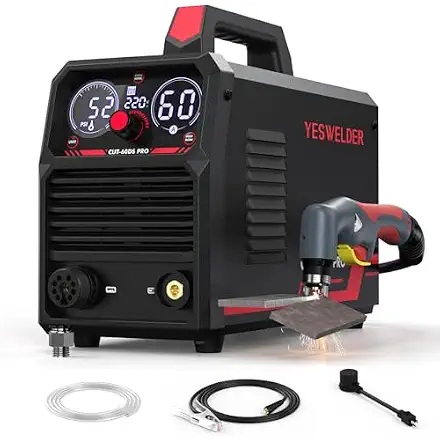


Our #1 Pick Today
Best Value
Plasma Cutter Buying Guide
Voltage
Voltage decides whether your new cutter is a tool or a paperweight. Before you add anything to the cart, walk out to your garage and look at what's actually on the wall — many buyers discover the 240 V requirement after the box arrives. Dual-voltage machines have become the default for good reason.
- 110V — Runs on a standard household outlet with an adapter, no electrician required. Perfect for apartment shops, mobile work, and thin material, but expect a real drop in cutting capacity — a machine that does 1/2 in on 240 V may only manage 1/4 in on 110 V. Check the breaker rating too; many need a dedicated 20 A circuit.
- 120V — Functionally the same as 110 V (the terms are used interchangeably in listings), and carries the same trade-offs: ultimate convenience, real capacity limits. Great for HVAC techs, body shops, and anyone who cuts thin metal in places without a welding outlet.
- 220V — The standard for serious cutting. Unlocks a machine's full rated thickness and duty cycle. You'll need a proper outlet — usually NEMA 6-50 or 6-20 — and possibly an electrician, so budget for that before you budget for consumables.
- 240V — Again, the same circuit as 220 V by another name. If a listing says dual voltage 110/220 V or 120/240 V, you're getting flexibility to run light work anywhere and heavy work at the shop, which is the best of both worlds for most buyers.
- 480V — Industrial three-phase power, found in production shops and manufacturing plants, not in home garages. If you have to ask whether you have 480 V, you don't.
For most people the smart buy is a dual-voltage machine with an included adapter — full power when you're plugged into the shop, portable capability when you're not. Just confirm the required breaker amperage before you commit, since the outlet is the expensive part.
Frequently Asked Questions
Expect to spend $250 to $500 for a capable entry-level machine that will handle most home garage work, $600 to $1,200 for a mid-range fabrication-class cutter, and $1,500 and up for premium American-made units. The purchase price isn't the whole story, though — consumables are a recurring cost, and a cheap machine with expensive or hard-to-find tips can end up costing more over a few years than a better cutter would have. Budget an extra $50 to $100 for a spare consumable kit right at the start.
Was this helpful?
Buy a machine rated to cut about twice the thickness you work with most often. If you mainly cut sheet metal and 1/8 in stock, a 40 A machine is plenty; if you regularly work with 1/4 in to 1/2 in plate, look at 45 to 60 A. Running a cutter at the absolute edge of its rating means slow, dirty cuts and rapid consumable wear, so a little headroom pays for itself.
Was this helpful?
Often, yes. Machines above roughly 45 A generally need a 220/240 V outlet, typically a NEMA 6-50, which may mean hiring an electrician if your garage doesn't have one. Dual-voltage machines are the popular workaround — they run on a standard 110 V household outlet for lighter work and switch to 220 V for full power. Just check the required breaker amperage before buying, because the outlet is usually the more expensive part.
Was this helpful?
Most plasma cutters require an external air compressor, and the listing will specify a CFM at PSI requirement — commonly somewhere in the range of 3.5 to 7 CFM at 60 to 90 PSI. Your compressor needs to deliver that continuously, not just in short bursts. If you don't own a compressor and don't want one, look for a machine with a built-in compressor, but understand that those trade away cutting capacity and duty cycle for the convenience.
Was this helpful?
For occasional light work, many of them genuinely are. Value brands can deliver solid performance at a fraction of premium pricing, and plenty of home shops run them for years without issue. The real trade-offs are inconsistent quality control, thinner customer support, and consumable availability — so before buying, search for that machine's torch type and confirm replacement tips and electrodes are cheap and readily stocked.
Was this helpful?
For most buyers, yes. A pilot arc lets the machine start cutting without the tip touching the metal, which dramatically extends consumable life and makes cutting rusted, painted, or expanded metal far easier. Contact-start machines are cheaper and fine for clean plate, but if you'll be cutting grating, farm equipment, or anything less than pristine, the pilot arc is usually the single best upgrade for the money.
Was this helpful?
Rated cut (sometimes called quality cut) is the thickness a machine cuts cleanly at a reasonable speed. Sever cut is the absolute maximum it can burn through — slowly, with a rough edge and heavy dross you'll spend real time grinding off. The big headline number on Amazon listings is usually the sever cut, so shop by the rated figure and treat the sever number as a technicality rather than a capability.
Was this helpful?
If your shop does a bit of everything and space is tight, a combo unit that pairs plasma cutting with TIG or stick welding offers excellent value and saves floor space. The trade-off is that combo machines rarely match a dedicated cutter at any single process, and a fault takes all your capabilities offline at once. If cutting is your primary need or you cut daily, a dedicated machine is the better long-term buy.
Was this helpful?
Our #1 Pick Today
Best Value
Keep Exploring
More categories to help you find the perfect match.